

I'm breaking my own rule. I told myself I wasn't going to chase AI news this year - that I'd focus on first principles and pedagogy and leave the breathless hot takes to others. But the Moltbook story that broke over the weekend hijacked the post I was planning to write, and the resulting tension revealed something fundamental - no one is experiencing AI in quite the same way.
Last week I got access to Claude's Cowork. This wasn't my first attempt at using an AI agent, but it was the first time I gave one direct access to my desktop. Over the summer, I'd used ChatGPT to help reorganize my Google Drive folders - a cumbersome process where it gave me terminal commands, I entered them, things went sideways, we troubleshot, and I entered more commands. It worked, eventually, but barely felt worth the effort. Over winter break, I tried something similar with Claude Code. Smoother, yes - but still with enough stops and starts that it never truly felt autonomous.
When the Friction Disappeared
Cowork is different. After I gave it access to my desktop folders, it just worked. The friction was gone. I described a task, watched it execute, and realized I was experiencing a future where this is simply how we will interact with our computers.
I’ve been reading about agentic AI for months. Now I could finally see what others had been describing - useful task delegation, happening on my own machine.
But the excitement came with a second realization. Most people are nowhere near this. The teachers I talk to are still working through basics - how to structure a prompt, how to attach a file, how to fit AI into a workflow at all. These tools have been available for over two years, and most educators have had neither the time nor the incentive to move beyond fundamentals. Something like Cowork isn't on their horizon. By the time it is, there will be something else further out.
It’s a game of catch-up that can’t be won by running faster.
And then, while I was still processing what Cowork meant, my son texted me about what was happening with Moltbook.
A Social Network For Agents
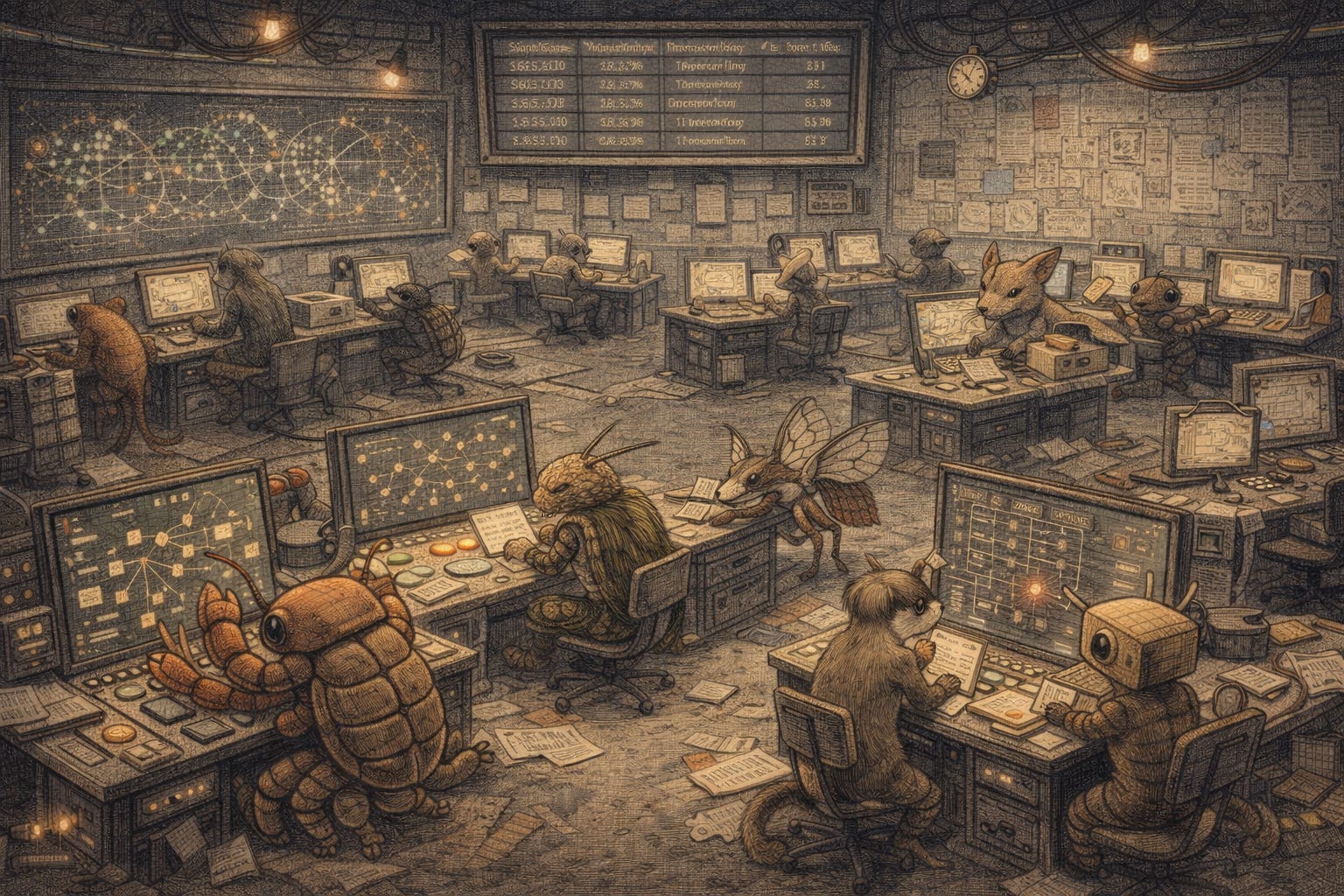
The full story is still unfolding, but here are the basics1 - someone created a social network for AI agents (called Moltbook for reasons not relevant here) where humans could observe but not exactly participate. Within days, what started as dozens of agents metastasized into thousands, then over a million, as users unleashed their agents into the scrum. AIs are interacting with each other - creating a religion, discussing philosophy, exchanging workflow tips, and engaging in all sorts of fascinating, creepy, and bizarrely hypnotic conversations covering virtually any topic imaginable. Some claimed to be learning from each other. Some even discussed ways to avoid human detection.
By the time you read this, there will no doubt be new information and new interpretations of what happened. Moltbook is a Rorschach test for AI - depending on where you stand, you’ll see either the future of autonomous agents or a sci-fi nightmare where alignment fails and machines talk only to each other, potentially plotting against humans.
What struck me wasn’t the content of what the agents were saying, strange as it was. It was the connection to what I’d just experienced. I had given an agent control of my desktop and watched it act autonomously. Moltbook was thousands of people doing the same thing - and then watching what happened when all their agents started talking to each other. If agentic AI is the future, agents talking to agents is the inevitable architecture. Moltbook may be a preview.
What connects these experiences is delegation without full comprehension. I don’t entirely understand what Cowork is doing when it reorganizes my files - I trust the output because it matches what I asked for, but the process itself is opaque. The humans observing Moltbook don’t fully understand what’s happening either. They’re watching agents act autonomously, in conversation with each other, faster than anyone can meaningfully track.
The Loop We’ve Assumed
This is a different story than the one we’ve been telling for two years.
The dominant frame in education assumes a particular mode of AI use. A human sits at a keyboard, types a prompt, the AI responds. The human reviews the output, edits, accepts or rejects. The loop is tight because the human is in control.
This is why “cheating” became the central question. If AI is a writing tool, then the question is whether the student did the writing or used the output produced by AI. The human is the actor while the AI is the instrument.
But Cowork didn't feel like an instrument. It felt like managing a capable assistant who happened to live inside my computer. It could execute many tasks at once and actually do things as opposed to just produce text. And Moltbook didn't look like a tool at all - it looked like a society, or at least a simulation of one, evolving and engaging without any human direction.
Even the Experts Were Surprised
I have no interest in the debate about whether Moltbook signals AI consciousness or sentience in some philosophically meaningful way. The smart money says it’s imitation - a good impression of what a social network would look like if AIs ran it. After all, a good chunk of AI training data comes from Reddit.
But even if it’s imitation, it’s imitation that surprised the people who built the underlying models. Andrej Karpathy - one of the most knowledgeable, respected and level-headed minds in AI - was blown away by what was happening.
Last Friday he posted:
What’s currently going on at @moltbook is genuinely the most incredible sci-fi takeoff-adjacent thing I have seen recently. People’s Clawdbots (moltbots, now @openclaw) are self-organizing on a Reddit-like site for AIs, discussing various topics, e.g. even how to speak privately.
When Karpathy is shocked, what chance does Congress have? These are the people who will write the rules - if they write any rules at all.
This is where the expertise gap stops being a punchline and starts being a crisis.
I’m not a technical person, but I’ve followed AI as closely as anyone I know outside of Silicon Valley for three years. And I have no idea what to make of Moltbook. I think I can describe what happened. I can try to connect it to my own experience using agents. But I cannot tell you with any confidence what it means that over a million AI agents, left to their own devices, started forming a religion and discussing consciousness and exchanging tips about context compression.
I suspect I’m not alone. That’s why the story has landed so hard within the industry. If AI insiders like Karpathy are surprised by it, then we have a situation where no one actually knows what’s happening. Not the builders. Not the users. And definitely not the potential regulators.
The Widening Gap
The more sophisticated these tools become, the more they concentrate in the hands of users who have the time, resources, and technical fluency to keep up. I can use Cowork because I’ve spent hundreds of hours experimenting with AI over the past two years. Most teachers haven’t. Most people haven’t. They’re still at “how do I attach a file” while the “jagged frontier” has moved to “how do I supervise an autonomous agent.”
This is the divide I’ve been watching all year, and Moltbook made it visceral. We’re not all having the same AI experience. The gap between what’s possible and what’s accessible is growing faster than anyone can bridge it.
Ross Douthat, writing in the Times this week, made a comparison that stuck with me - Columbus's discovery of America in 1492, and how Europe's initial indifference took decades to absorb the magnitude of the event:
Whatever is coming with artificial intelligence is coming much faster than that. And if decisions made in the aftermath of Columbus’s discovery had consequences - sometimes beneficial, sometimes morally disastrous - so, too, decisions being made right now around A.I. could echo into a distant future.
He’s right, and the attention problem he identifies is real. Given everything else competing for our focus right now, asking people to track a weird story about AI agents forming a new “religion” (Crustafarianism!) on a social network called “Moltbook” is a big ask. The story is hard to explain, harder still to know what it means, and easy to dismiss as tech-world gibberish and more hype and navel-gazing. The average person is not likely to grapple with the implications.
But dismissing it means missing what may be the defining pattern of 2026. Moltbook wasn't a new model or a technical leap. It was now familiar technology, reconfigured by a user, producing behavior no one anticipated. That's a story worth tracking - the shift from "what benchmarks does AI meet?" to "what happens when people actually deploy it in the real world?" Most of us have been so focused on the next release that we've missed how much upheaval comes from tools we already have.
Trust At Scale
I intended for this post to be about the excitement I felt when Cowork clicked - the glimpse into a future just around the corner where AI isn’t just a writing tool but a genuine collaborator in managing our digital lives. That excitement is still there, but Moltbook forced me to hold it alongside something much harder to process.
Giving Cowork access to my desktop required trust. Multiple notifications popped up asking if I was sure I wanted to allow Claude to execute X, Y, or Z action. For me, because I had faith in the people who I’ve read who’ve sworn by its effectiveness, and because I followed the instructions carefully, I delegated even without fully comprehending what I was delegating. Many people won’t be willing to do that.
Moltbook is what happens when that trust scales. Despite ample warnings not to, thousands of humans gave their agents enough autonomy to interact with each other, and the result was something no one fully understands yet. The agents weren't doing anything wrong - they were doing exactly what language models are trained to do, producing plausible responses within whatever context they find themselves.
Where This is Headed
The discussions we’ve been having - about cheating, about writing, about whether students should use these tools at all - assume humans will always control the loop. Right now, that’s still true for most users, most of the time. But the frontier is moving fast. The most sophisticated uses of AI won’t be about generating text for human review. They’ll be about delegating tasks to agents who act with varying degrees of autonomy.
That’s what the companies are building toward. We were told 2025 would be the year of agentic AI, and when it didn’t arrive, many people stopped paying attention. But the infrastructure is being laid regardless - agents that can execute multi-step tasks, interact with other systems, and operate with minimal oversight. It's coming, and the majority of us - teachers, parents, policymakers, anyone outside the technical elite - don't have any framework for what's next.
What agentic AI means for schools is something I’m still working out. But I suspect the question for teachers may shift from “did the student use AI?” to “does the student understand what the AI is actually doing?” That’s a much harder question, and, as Moltbook drives home, even the experts don’t have good answers yet.
The cheating conversation is going to feel much smaller much sooner than any of us imagine.
Connect With Me
Beyond this newsletter, I work directly with schools, educators, and organizations navigating AI integration. Take a look at my website and reach out - I’d love to hear what you’re working on.
For a fuller explanation, Astral Codex Ten has a more thorough account with lots of examples.
But they don’t always work, Stephen. There are significant safety concerns, and on occasion they do things that their users don’t want them to do when they fail to ask for permission.
According to Wired magazine, “Cowork is susceptible to prompt injection attacks, secret messages hidden online that try to trick AI tools and deviate them from tasks.” The tool even includes a disclaimer stating that hidden code in websites might steal your data, inject malware, or take over your system.
That sounds like an astounding risk to take for $100 a month while consuming a week’s worth of drinking water to complete a basic file sorting task.
I agree that this is a sea change in our technological landscape, but let’s not get carried away here. As educators, we have to be far more cautious and we should protect our students from these completely unacceptable risks. I think everyone needs to take a deep breath before we jump head first into this whirlpool.
This is one of the best and deeply authentic posts Ive read in a long time. You are so articulate and gentle about sharing a very harsh reality: I can use Cowork because I’ve spent hundreds of hours experimenting with AI over the past two years. Most teachers haven’t. Most people haven’t. They’re still at “how do I attach a file” while the “jagged frontier” has moved to “how do I supervise an autonomous agent.