


There is nothing more useless than doing efficiently that which should not be done at all.
Peter Drucker
It's late April and I'm running on fumes. Students and teachers everywhere can see the finish line, but it's still far enough away to be more distraction than relief. Overextended and buried under a to-do list a mile long, if ever there was a moment when a time-saving tool would be critical, this is it. And yet AI is not that tool - at least not in the way it’s frequently pitched.
The availability of powerful generative AI makes it very easy to do things that probably should not be done at all. A core skill in the coming years will be determining when, why, and for what purpose AI should be used. Because, make no mistake, it will continue to be used by millions of people, and many of those people will be students and teachers.
Six Weeks of Time Savings? Really?
If there is one message that unites nearly every report, conference keynote, and vendor claim about AI in education, it is that AI can save teachers time. The January Brookings report on AI and students summarized the consensus:
AI’s benefits extend to teachers: by reducing time on tasks, AI allows teachers to focus on individualized student attention and enhance curriculum and instruction.
NPR’s coverage of the report cited a U.S. study claiming teachers who use AI save an average of nearly six hours a week and about six weeks over a full school year. That number deserves scrutiny.
The "U.S. study" in question is a Walton Family Foundation/Gallup survey from June 2025 - predating the Brookings report, which cites it. The methodology was key -teachers who already used AI weekly were asked to estimate, to the nearest half-hour, how much time AI saved them on individual tasks. Those self-reported estimates were then summed. The result was 5.9 hours per week or, cumulatively, six weeks per year.
I don't buy it. The Brookings report itself hedges the claim in a section titled "Time savings only occur if teacher workloads remain steady" (Box 05 on p. 40 of the full report). More importantly, neither the Brookings report nor the Walton study can specify what is actually being done with the time saved. As Tom Daccord noted on his Substack:
The Gallup-Walton data could not answer the question that matters most for learning: What happens after the time is saved?
Even if AI is saving teachers time, the benefits only accrue if that time goes back into individualized attention and deeper instruction. AI time savings might simply mean that teachers pack up and go home earlier. It might mean the time is absorbed into more administrative and ancillary tasks. The difference matters because if one of the major selling points for teachers using AI is to “save time,” then it is imperative that the time saved is used wisely. But I question the entire narrative that AI is saving teachers time in the first place.
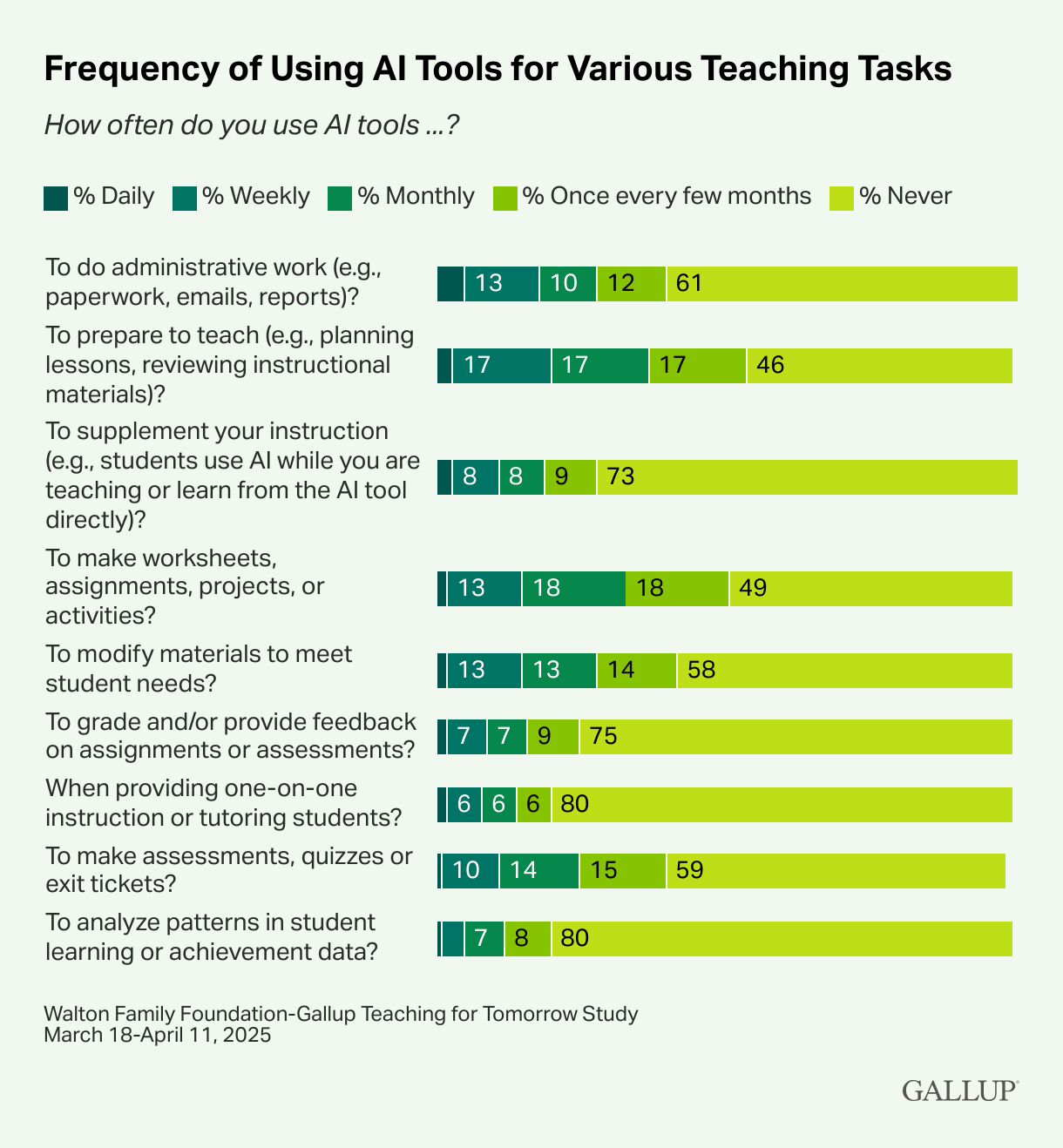
The Walton/Gallup survey's own data complicates the six-week headline. Look at the frequency chart. Eighty percent of teachers have never used AI for one-on-one tutoring. Fifty-nine percent have never used it to make assessments. Seventy-three percent have never used it to supplement instruction. The "six weeks" figure comes from frequent users - a group that represents, at most, a third of the teaching population. Which means, for most teachers, AI time savings remain entirely theoretical. It’s also worth asking - if the time savings is so dramatic, why aren’t more teachers using it?1
The majority of tasks for which teachers are using AI are either tasks they were doing already or, in the case of something like modifying materials to meet student needs, ones which AI enables in a way that wasn’t feasible before.
This exposes a subtler problem with how time savings get measured. Consider a teacher who uses AI to build an elaborate differentiated worksheet in 20 minutes. She estimates that creating it on her own would have taken an hour and reports 40 minutes saved. But without AI, that worksheet never gets made. The actual time impact is plus 20 minutes, not minus 40. In that instance, the survey measures savings against a hypothetical task that would never have been undertaken. Multiply that logic across nine task categories and you get 5.9 hours of savings that potentially exists only on paper. The worksheet may well be superior. That's a quality argument, and a potentially legitimate one. But it is not a time-savings argument.
What the Workplace Data Actually Shows
Regardless of the inconsistency of self-reports, there is data available that undercuts the notion that AI time savings in the workplace translate into actual efficiency gains at all. Recent studies measuring behavior rather than perception tell a different story.
The ActivTrak 2026 State of the Workplace report, released in March 2026, analyzed 443 million hours of behavioral data across 1,111 organizations and more than 163,000 employees. Their conclusion was blunt: “The data is unambiguous: AI does not reduce workloads.” Among users comparing 180 days before and after AI adoption, time spent across every measured work category increased - ranging from 27% to 346%. No category decreased. Meanwhile, the average focused, uninterrupted work session fell to just over 13 minutes, down 9%, and continuing a three-year downward trend. The optimal band of AI usage turned out to be extraordinarily narrow - employees spending 7-10% of their work hours in AI tools showed the highest productivity of any group, yet only 3% of workers fell within that range.
A separate BCG study of nearly 1,500 full-time U.S. workers, published in the Harvard Business Review, also in March 2026, identified a phenomenon they called “AI brain fry.” The primary driver wasn’t AI use itself but the cognitive burden of overseeing its output. Workers with high AI oversight loads reported 14% more mental effort, 12% greater mental fatigue, and 19% more information overload. Those experiencing the condition made 39% more major errors and were significantly more likely to consider leaving their jobs.
These are not education-specific studies. But I’m not sure why we would assume the findings would be significantly different for teachers. Evaluating what AI produces is mentally demanding work, and the overall pattern across industries is consistent: AI adds new layers of work rather than reducing existing ones.
The Novice Teacher Problem
Imagine you are new to teaching. You’ve completed your training and you are organizing your course materials for the first time. What lesson should you start with? How should you set up your classroom? An AI chatbot will happily provide answers to all of these questions and some might be generically helpful. But which ones are right for your students, in your room, given your strengths? You have no way to know.
The ability to navigate the hundreds of decisions that go into teaching comes with experience - the kind that requires following your own instincts, getting real-time feedback from actual students, and adjusting the next day to adapt to your circumstances.
LLMs are great at generating ideas. Many are creative and potentially useful. An experienced teacher can scan them quickly and locate the one or two that might lead to a productive tweak. Newer teachers don’t have that luxury. They haven’t made the hundreds of mistakes that allow them to grab the one useful suggestion among dozens.
This is a judgment problem, and chatbots cannot impart judgment.
The “brain fry” finding is particularly relevant here. The primary driver of cognitive strain wasn’t using AI itself but overseeing the output. And that presupposes a major assumption – that teachers are actually carefully reviewing what AI produces. As models become more advanced and more verbose, the cumulative effect of reading and evaluating AI-generated text can easily take longer than starting from scratch.
Veteran Teachers Have A Different Problem
Even for experienced teachers, the time-savings pitch doesn’t hold up, though for different reasons.
Over the past year, I’ve written about several ways I use AI in my own practice - building a Claude Skill to audit lessons using the Understanding by Design framework, and creating interactive web modules for specific activities in my classes. Each of these was a significant investment that I believe paid off (or will pay off) in better student outcomes. But none of them saved time.
The lesson audit produced useful, actionable feedback. It identified misalignment between what I wanted students to learn and what my activities actually assessed. But evaluating every suggestion required 30 years of teaching experience. It was helpful but not “efficient” – at least not in the way the Brookings report envisions “time savings for teachers.” Performing an AI audit for every lesson during the school year is simply not realistic. That’s useful summer work.
The interactive modules are, I think, genuinely effective teaching tools. They are also time-consuming to build and require significant design thinking before AI can execute anything usable. My abiding mantra when creating or redesigning a lesson has been: what is the value add, and is it worth doing? AI hasn't changed that question.
Even for teachers who aren’t building custom tools, AI is still unlikely to save them time. Generating a quiz is easy. Proofreading questions, verifying outputs, and ensuring the product meets your classroom standards is not. Creating new worksheets from AI-generated ideas may be rewarding and great for your students. But the measure of “time savings” is always against the alternative – using the original lesson. If AI leads you to do something different and do it well, it’s a worthy goal, ideally one that leads to better teaching and learning. It’s not a shortcut.
Depth, Not Speed
The argument I am making is not that AI cannot help teachers teach better. Used effectively, AI is exceptionally good at helping teachers improve their own work. The newer models and capabilities offer possibilities for teachers with the curiosity and - most critically - the time to learn about and play with them.
All of the best use cases require significant up-front investment. Using AI effectively may also increasingly require access to the top-tier frontier models - an entirely different issue.2 These two points cannot be sugarcoated. AI opens up new possibilities precisely because it enables work that wasn’t possible before - not because it makes existing work faster.
The ActivTrak data confirmed what I’ve found in practice. AI doesn’t replace what we’re already doing. It amplifies it. But the claim that it saves time the way a dishwasher saves time or a calculator saves time is not what I've experienced.
Which brings me back to Drucker. AI makes it efficient to do things that shouldn’t be done at all - churning out generic lesson plans no teacher has examined, producing feedback no student will read, and generating worksheets that exist because they’re easy to create rather than because they serve a clear learning goal. If that’s the primary way in which teachers are using AI, that’s the Drucker problem in a nutshell. Efficiency without judgment is worse than inefficiency.
Time is the most important resource a teacher has. Be wary of anyone who tells you AI will give you more of it. What AI can do - for teachers willing to go deeper - is open up choices that didn't exist before. Those choices mean more decisions, and every one costs time and attention.
I’d love to hear from other teachers about their experience with AI as a time-saving tool. Am I wrong? What am I missing? Let me know your thoughts in the comments.
Connect With Me
Beyond this newsletter, I work directly with schools, educators, and other institutions about pedagogical questions raised by AI. Take a look at my website and reach out - I’d love to hear what you’re working on.
Obviously, as with any study or research report involving AI usage, the data is a moving target given the speed with which the technology is improving and being adopted. But my core argument remains the same - I need more granular data on what specific tasks teachers are saving time and, critically, whether those tasks are leading to improved learning outcomes.
I wrote about the emerging cost and access gap in AI models in my recent piece on the Claude Mythos story.
The novice teacher who can’t evaluate AI-generated lesson plans and the student who can’t explain AI-generated answers are the same problem at different altitudes. Both have output without ownership. Both look competent on paper. Both collapse under questioning.
Your point about the worksheet that never would have existed is the one that should keep people up at night. We’re not measuring time saved. We’re measuring time spent on work that didn’t need to happen — and calling it efficiency. The same thing is happening on the student side. A kid produces a polished lab report in twenty minutes that would have taken two hours. The teacher sees improvement. But the two hours wasn’t waste. It was where the thinking lived.
The BCG “brain fry” finding lands hard from the classroom too. I watch students experience the same thing — not from using AI, but from trying to supervise output they never built the architecture to evaluate. The cognitive load doesn’t disappear. It just shifts from production to oversight, and oversight without prior mastery is just confusion with a better interface.
Drucker had it exactly right. And the version I’d add from the student side: there is nothing more dangerous than doing fluently what was never understood at all.
Let’s suppose that AI really did get teachers back six hours of time a week (I agree with you that it doesn’t). Why is there even a narrative that teachers should do something else with this time?
Teacher already work 50 to 60 hours a week and they do not get paid for that overtime. If they manage to get 6 hours of time back, shouldn’t they just get the time back?
Why do we continue to have a narrative that it’s ok for teachers to work this many hours without being paid for it?